AI-assisted image geolocation can extract clues faster than a manual first pass. It can read visible text, describe road and building features, identify landmark-like shapes and rank possible places. But accuracy is not a fixed percentage. It changes with image quality, scene uniqueness, available context and the ability to verify candidates.
The right question is not "Can AI find the location?" The better question is "What level of location is supported by the evidence?" Sometimes the answer is an exact viewpoint. Sometimes it is a city, a region, a country or no reliable location. This is why LoadQ focuses on explainable clues and reviewable candidates.
| Image evidence | Likely confidence | Expected result |
|---|---|---|
| Readable street sign plus matching map view | High | Street or exact viewpoint candidate |
| Landmark plus surrounding geometry | High to medium | Place or district candidate |
| Architecture and road style only | Medium to low | City or regional lead |
| Generic indoor scene | Low | Often no reliable location |
| Cropped or blurred screenshot | Variable | Depends on remaining text and context |
1. Distinctive clues improve accuracy
01Specific evidence beats broad style
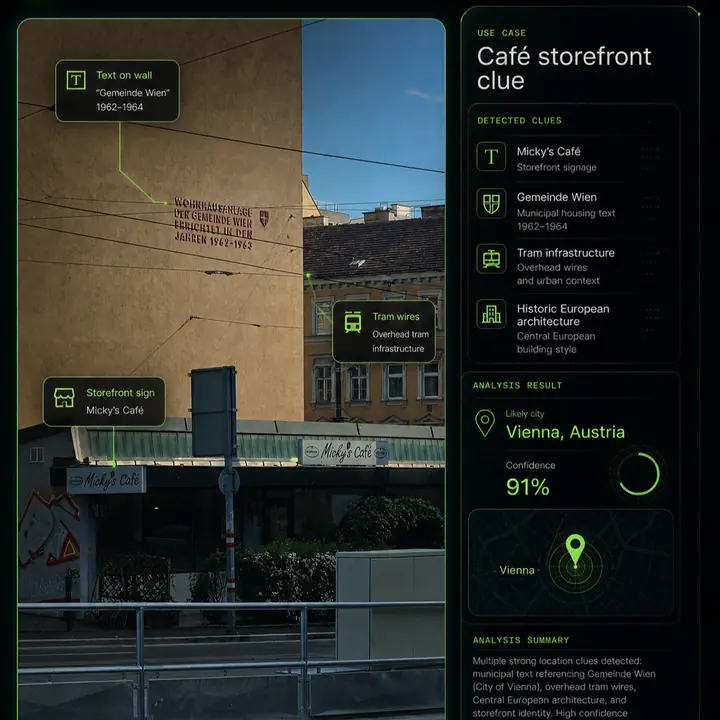
Readable local text, unique landmarks, public transport labels and matching map geometry improve accuracy because they can be checked independently. Broad clues such as "urban street" or "European architecture" are useful only for narrowing possibilities.
2. Image quality changes what can be known
02Resolution, crop and blur matter
A high-resolution original may reveal street names, signs and small landmarks. A compressed screenshot may remove those details. AI cannot reliably infer evidence that is not visible.
3. Verification matters more than a confident sentence
03A candidate is not a conclusion
AI may propose a plausible place, but the result should be checked against maps, street-level imagery, web evidence and contradictions. A confident explanation is only useful if the visual evidence actually matches.
4. Confidence should match the evidence level
04Exact, city, region or unknown
Do not force exact coordinates from weak images. If the evidence supports only a city or country, say that. A broad honest result is more valuable than a precise but unsupported one.
5. AI is strongest as a reasoning assistant
05Use AI to extract, rank and explain
The strongest AI geolocation workflows expose the clues behind a candidate: OCR text, scene evidence, landmark signals, map context and remaining doubts. That makes the result auditable by a human reviewer.
Common mistakes
- Reading an AI answer as proof instead of a candidate.
- Expecting exact addresses from generic images.
- Ignoring uncertainty when evidence is weak.
- Failing to verify a plausible candidate with maps.
- Using AI geolocation for harassment or exposing private people.
FAQ
How accurate is AI photo geolocation?
It depends on evidence quality. Strong visible clues and map verification can support high confidence. Generic scenes may not support a reliable location.
Can AI find coordinates from every image?
No. Many images lack enough distinctive evidence. In those cases, the honest result is broad or uncertain.
What improves confidence?
Independent agreement between text, landmarks, roads, architecture, terrain and map geometry.
Test an image with evidence-aware AI.
Upload a photo and LoadQ will extract visible clues, rank candidates and show why the result is or is not strong.